Texas Sodium Bentonite, Inc. Products

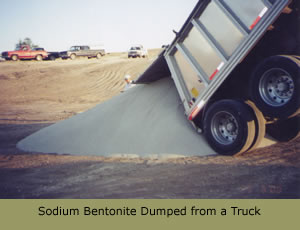
Sodium Bentonite dumped from a truckWe mine and produce high quality sodium bentonite clay. This unique clay will generally swell to double it’s own dry volume when it comes in contact with moisture and when completely hydrated it has the capabilities to swell up to 18 times it’s own dry volume. Our products are 100% natural and do not require any chemicals or additives to enhance this clays swelling capabilities, therefore this clay is non-toxic to birds, fish, wildlife, livestock or humans. We produce six different screen size granular products used in various markets. Our smallest screen size is our minus thirty (-30) that is approximately the size of very fine sane. This product is not in powder form. And our largest product being our hole-plug material is approximately the size of a small marble.

Our products are sold in bulk quantities by the 25-ton truckload only delivered in hoper bottom trailers or end dump trailers directly to pond sites, in super sacks, commercial bags weighing approximately 3000 pounds each with four straps on the top of the bag and a spout on the bottom of the bag for easy distribution, and in the 50-pound bags. Bagged products are sold by the bag, by the ton, and by the 22-ton truckload. On order of a ton or more, the bagged products require a front-end loader, forklift, or tractor with forks on the front to unload this product upon delivery.

The key to successfully using sodium bentonite clay to seal a pond is to use the recommended quantity based on the size of the area you intend to treat and the type of soil you are working with and to apply the product properly. Apply the product evenly being careful not to leave any voids, over the area you choose to treat. Then regardless of the application method you choose to use; the blanket method or the mixed blanket method, compact the area after application when possible.

Sodium Bentonite Recommendations based on Soil Types:

The following recommendations are for soils with no prior soil testing to determine the recommended amount of sodium bentonite needed to seal a particular soil.

  • When treating soils with a good percentage of clay and some sandy areas (no rocks or gravel), the recommendation is 4 pounds of sodium bentonite per square foot or approximately 1/2 “ thick layer.
  • When treating soils with a large percentage of sand and some clay (no rocks or gravel), the recommendation is 6 pounds of sodium bentonite per square foot or approximately ¾” thick layer.
  • When treating soils that are extremely sandy with little to no clay present and rocks or gravel present, the recommendation is up to 8 pounds of sodium bentonite per square foot or approximately 1” thick layer.

Years ago the NRCS or Soil Conservation Agents recommended using 1 to 3 pounds of sodium bentonite per square foot. Texas Sodium Bentonite, Inc. has been sealing ponds for over 14 years and after many years of field-testing a high quality sodium bentonite with various soils; we determined that this recommendation was not adequate to successfully seal most soils. These tests proved that the more porous soils did require more sodium bentonite clay to successfully treat. Due to the soils subject to changing every ten (10) feet, a pond may have a large percentage of good clay soil overall, however if the pond is not holding water, it generally has one or more areas of sand, rock, or gravel also. Therefore, unless you plan on spot treating your pond whereby you treat just the isolated areas you suspect is leaking, you will need to follow the recommendations listed above for the best results.

Some landowners can get by with treating just a portion of their ponds such as the bottom portion, dam area, or isolated areas suspected of leaking, while others must treat the entire pond area to successfully stop the leaking. On larger ponds that go completely dry, we generally recommend treating the pond in stages (if possible) to see if you can seal a pond without going to the added expense of treating the entire pond. In a large percentage of the ponds we treat, the bottom portion of the pond is usually the problem, so we recommend you treat this area first. The bottom portion of a pond is approximately 30 percent of the overall pond size, so when treating this area the recommended amount will generally cover a few feet up the side of the pond also. On newly constructed ponds, the landowner may want to treat the entire pond while the dirt contractor building the pond is available with equipment still at the job site to prevent additional cost in bring equipment back later.

On ponds that will hold at a certain water level, we first recommend treating just the area above this water level to see if the problem is in the sides of the pond. If after treating the side areas and the pond continues to lose water down to this same water level, then more than likely your problem is an underground spring in the bottom of the pond that will not allow the pond to fill and stay full. This is largely due to the water pressure. As the pond fills from this spring it will reach a certain pressure level and stop filling at this point. It will generally maintain this water level. However, it will not allow the pond to fill beyond this point. When it rains and the pond fills, the water pressure increases which forces the water out the spring until the water level and pressure increases which forces the water out the spring until the water level and pressure level return to the previous pressure the spring maintained. Therefore, if you have this problem with your pond, you must decide if you are willing to seal off the spring in order to fill the pond. Generally, it will take more than the recommended amount of sodium bentonite clay to seal an underground spring. Please contact our office at 325-885-2339 for additional information.

About Texas Sodium Bentonite, Inc. | Pure Blanket Method | Mixed Blanket Method | Sprinkle Method | What Is Sodium Bentonite? | Symptoms of Leaky Ponds | Stopping the leak | How to Calculate the Volume of a Well | Plugging Abandoned Water Wells | Texas Sodium Bentonite, Inc. Products | Environmental Characteristics of Clays and Clay Mineral Deposits | Many Uses of Sodium Bentonite | Material Safety Data Sheet | Soil Analysis | Home

©2010 All Rights Reserved Texas Sodium Bentonite    e-mail: info@texassodiumbentonite.com

Privacy Policy | Terms of Use | Contact Us
Proud Member of the WE LOVE TEXAS Network, Supporting Texas-based Small businesses!